Headline: Jonas Wood's Flattened Worlds Arrive in London with Quiet Force
Summary: Gagosian Grosvenor Hill presented new paintings by Jonas Wood that compress domestic life into vibrant, pattern-dense surfaces where perspective becomes a game rather than a rule. The exhibition revealed an artist at full command of his visual language, offering collectors entry points into work that bridges intimist traditions with Pop sensibilities.
The Self-Portrait as Inventory
A man stands beside a Home Depot cart, joint in one hand, phone in the other. At ninety by ninety-eight inches, the canvas flips the usual power dynamic. The viewer feels watched. Jonas Wood's Self-Portrait with Home Depot Cart, Joint, and Phone (2024) reads less as confession than as inventory: errand, vice, tether. The cart's orange vibrates against flattened green foliage. Nothing recedes. Everything presses forward.

Jonas Wood, Self-Portrait with Home Depot Cart, Joint, and Phone, 2024. Oil and acrylic on canvas, 90 × 98 inches. Courtesy Gagosian.. Source: gagosian.com
Wood, born in Boston in 1977 and based in Los Angeles since completing his MFA at UC Irvine in 2002, has spent two decades building a visual vocabulary from the ordinary. Plants. Basketball courts. Interiors cluttered with evidence of living. He begins with photographs, then alters, cuts, and rearranges them by hand into collaged drawings before translating them to canvas in oil and acrylic. The result is compression. Objects that should sit in separate planes stack like cards.
The Gagosian Grosvenor Hill exhibition, which ran from October 7 through November 23, 2024, at 20 Grosvenor Hill in London, gathered new paintings that extend this approach without softening it. Eight installation images by Maris Hutchinson show the canvases against white walls, their saturated color doing the work the gallery refuses. Miami Shade House (2024), sixty-six by sixty inches, sets plant forms inside a greenhouse structure, then turns that structure into a pretext for collision. The building's geometric armature fights the organic sprawl it contains.
Jonas Wood, Miami Shade House, 2024. Oil and acrylic on canvas, 66 × 60 inches. Courtesy Gagosian.. Source: gagosian.com
Gagosian's press materials call the work an "interplay of apparent opposites," describing it as both "exuberant" and "obsessive." The language fits. Wood's surfaces verge on compulsion, every inch worked, negative space nearly erased.
Compression as Method
Wood's still lifes do not offer respite. They tighten the room around the eye.
Office Still Life (2024), eighty-eight by sixty-four inches, makes the method plain. Everyday objects, the detritus of a workspace, pack into a dense graphic arrangement. Nothing breathes. A coffee cup, a stack of papers, a potted plant: each receives the same flattening treatment, rendered with the same insistence. The painting does not reproduce easily. That resistance is part of its charge.
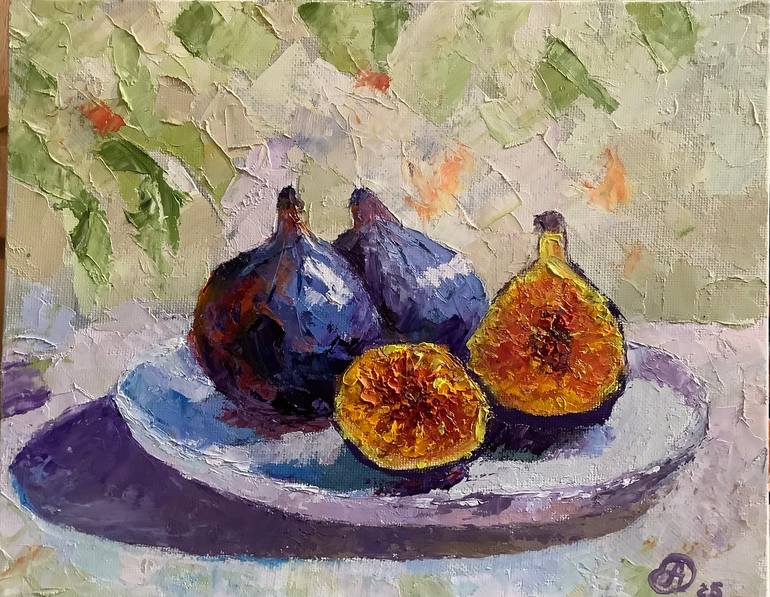
Jonas Wood, Office Still Life, 2024. Oil and acrylic on canvas, 88 × 64 inches. Courtesy Gagosian.. Source: www.saatchiart.com
Roberta Smith, art critic for The New York Times, has written of works that resist reproduction: "In person they have a presence, a quality of light that the camera misses." Wood's surfaces reward proximity. Acrylic sits atop oil in ways that only register up close. Edges blur, then snap into focus. From across the room, a seamless pattern. At arm's length, a record of decisions and revisions.
Influences surface without turning dutiful. Pattern-heavy interiors recall Pattern and Decoration of the 1970s and 1980s, with Robert Zakanitch's wallpaper-like accumulations as a useful reference point. Flattened California light suggests David Hockney's pools and gardens. The photographic collage method nods to Richard Hamilton and the origins of British Pop. Wood absorbs these histories and produces something that feels native to the Instagram era, even as it refuses the screen's logic.

Robert Zakanitch, untitled pattern work, 1970s. Example of Pattern and Decoration movement referenced in Wood's practice.. Source: www.artforum.com
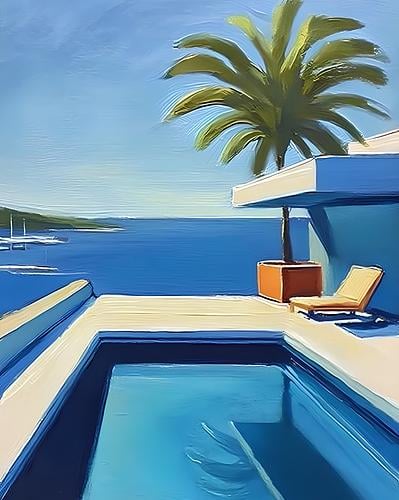
David Hockney, pool and garden work exemplifying the flattened California light referenced in Wood's visual language.. Source: www.artfullywalls.com
A concurrent presentation of prints at Gagosian Burlington Arcade, also opening October 7, offered a smaller-scale entry into the same visual language. For collectors tracking the market, prints can function as a lower-cost point of access, with Gagosian's provenance documentation intact.
The Plant as Character
Plants in Wood's paintings do not sit quietly in the corner. They take over.
Again and again, the potted specimen or greenhouse occupant asserts itself against its container, its environment, even the canvas edge. Miami Shade House places tropical foliage within an architectural grid meant to constrain it, yet the structure reads as barely adequate. Leaves push against the shade frame. Fronds overlap until space becomes illegible. The greenhouse turns into a cage that cannot hold.
That tension between containment and overflow runs through Wood's practice. His wife, the artist Shana Lutker, shares his Los Angeles studio. The domestic imagery saturating the work comes from observed life, not invention. The plants are real plants. The interiors are real interiors. The paintings are not documents. They are compressions of experience into pattern, translations of three-dimensional space into surfaces that insist on their flatness.
Wood's 2023 mural on the MOCA Los Angeles façade pushed the same language to architectural scale. The Grosvenor Hill paintings, most under eight feet in any direction, feel intimate by comparison, yet they share the mural's insistence on graphic clarity. At any size, a Wood painting announces itself quickly: saturated palette, colliding patterns, a refusal of atmospheric perspective.

Jonas Wood, MOCA Los Angeles façade mural, 2023. Courtesy the artist and Gagosian.. Source: gagosian.com
For collectors, the plant paintings provide one of the most consistent threads through the catalog. They appear across his career, from early still lifes through the present exhibition, and they anchor his market identity. A serious collection often seeks at least one example, ideally from the last five years, when technical control has reached its current pitch.
Market Position and Collector Considerations
Behind the paintings sits a carefully managed apparatus.
Gagosian has represented Wood exclusively since 2014. The London exhibition marked one of multiple solo presentations across the gallery's global network. Prior New York shows at Gagosian ran April 5 through May 25, 2018, and April 24 through July 19, 2019. Upcoming commitments include a Beverly Hills solo (March 12 through April 25, 2026) focused on tennis court paintings and a Gstaad group show alongside Irving Penn (February 12 through April 6, 2026). The schedule signals continued investment and controlled supply.
Primary market pricing for works in this exhibition was available through gallery inquiry. Comparable large-scale Wood paintings have exceeded one million dollars at auction, though recent specific sale data remains difficult to confirm publicly. Works under fifty inches offer six-figure access points, while major canvases approaching ninety inches command premium pricing. Condition concerns for recent work are minimal given the 2024 dating. Authentication runs through Gagosian, with certificates of authenticity and catalogue inclusion.
Wood's position within the broader LA figurative revival invites both enthusiasm and skepticism. Critics who favor abstraction sometimes treat his market success as commercial accommodation rather than artistic necessity. The paintings resist that dismissal. They compress and flatten with intelligence, not autopilot. The collector's question is durability: whether this visual language can sustain critical and market attention over decades.
The tennis court paintings announced for Beverly Hills in 2026 suggest a serial mindset, coherent bodies of work built around specific subjects. The strategy has historical precedent, and it has market logic. Collectors can acquire across series and build depth. For those considering Wood now, the London exhibition offered a chance to secure work from his domestic period before sports imagery potentially shifts attention and pricing elsewhere. The window remains open. It will not stay that way.