After two years of decline, the global art market grew again. The 2026 Art Basel and UBS Global Art Market Report, authored by Dr. Clare McAndrew of Arts Economics, records a 4% expansion to $59.6 billion in 2025. That total remains below the 2022 peak. Still, the market found its footing.
Channel dynamics tell the real story. Auctions rebounded 9%, while dealer sales rose just 2%. Noah Horowitz, Art Basel's CEO, called the moment a "strategic inflection point" at the report's launch, crediting more disciplined dealer strategies at major fairs. Paul Donovan, UBS Chief Economist, pointed to "democratisation" via lower-entry digital participation, while noting that value remains concentrated among a small number of artists.
Transaction volume rose 2% to 41.5 million sales worldwide. More people bought art, often smaller works, often online, often cautiously. Online sales fell to $9.2 billion, the lowest since 2019, even as activity clustered around works priced between $5,000 and $50,000. Donovan observed that new collectors "stick their toes in the water" through Instagram discovery and gallery websites before committing to purchases that bring shipping and insurance into play.
Geography stayed fixed at the top. Autumn 2025 auctions in New York produced all ten lots above $10 million, and 39 of the top 50. The high end remained overwhelmingly American.
The Barbell Effect and What It Squeezes
Contemporary art did not rally. It did not collapse. It held steady at $1.4 billion in auction sales, a kind of resilience in a market still recalibrating.
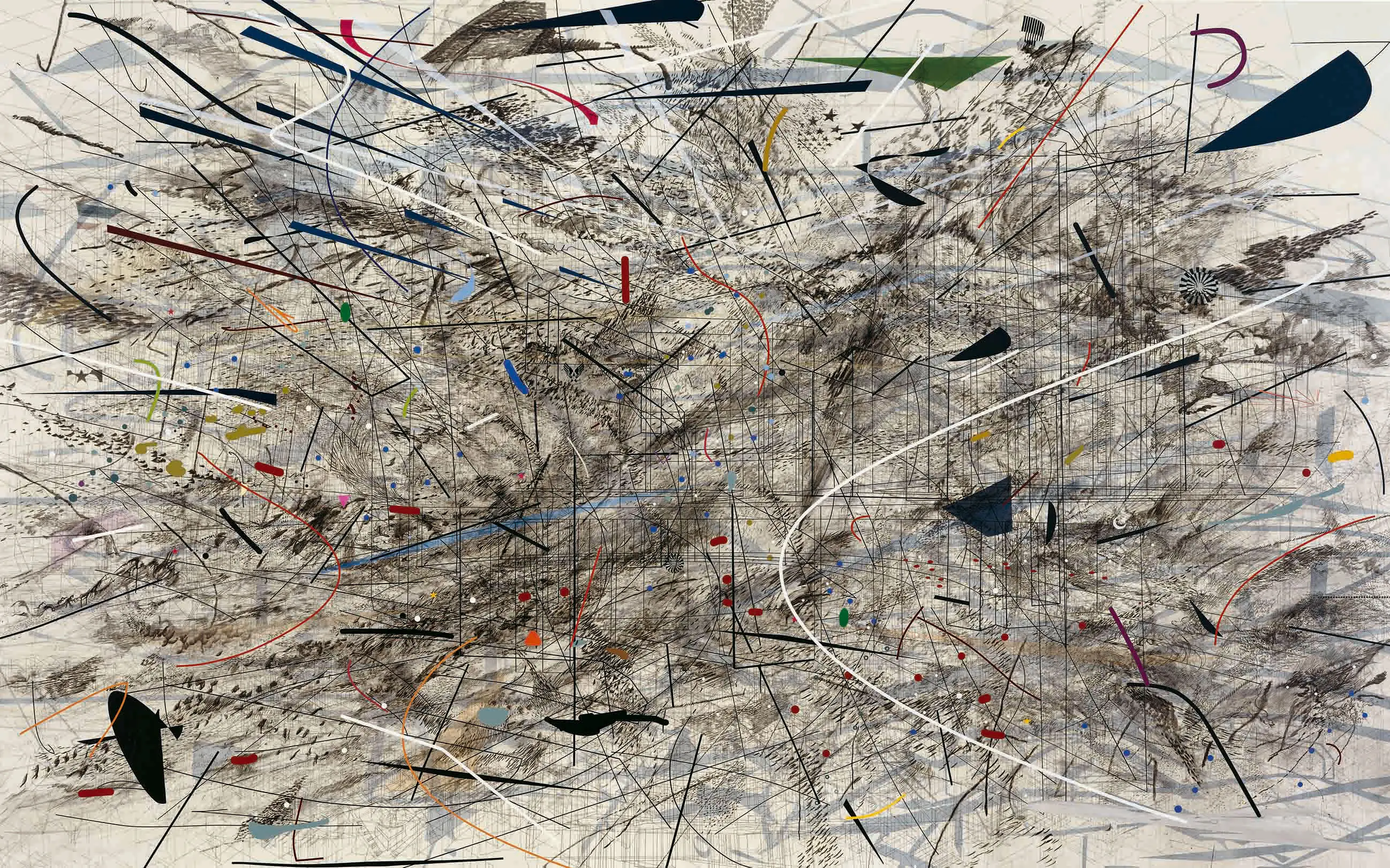
Julie Mehretu, Black River, 2024. Ink and jacquard on canvas. Courtesy Hauser & Wirth. Source: issuu.com
Other categories moved more sharply. Modern rose 9% to $2.4 billion. Impressionist and Post-Impressionist works jumped 47% to $1.8 billion, propelled by Gustav Klimt's 1914–1916 portrait Bildnis Elisabeth Lederer, which sold for $236 million at Sotheby's New York in November 2025. Contemporary, by contrast, persisted.
The report's "barbell effect" clarifies where demand concentrated. Sales above $10 million increased 30% in value and 9% in volume. Sales above $1 million rose 21% in value and 15% in lots. Below $50,000, value and volume each slipped 2%. The middle tightened.
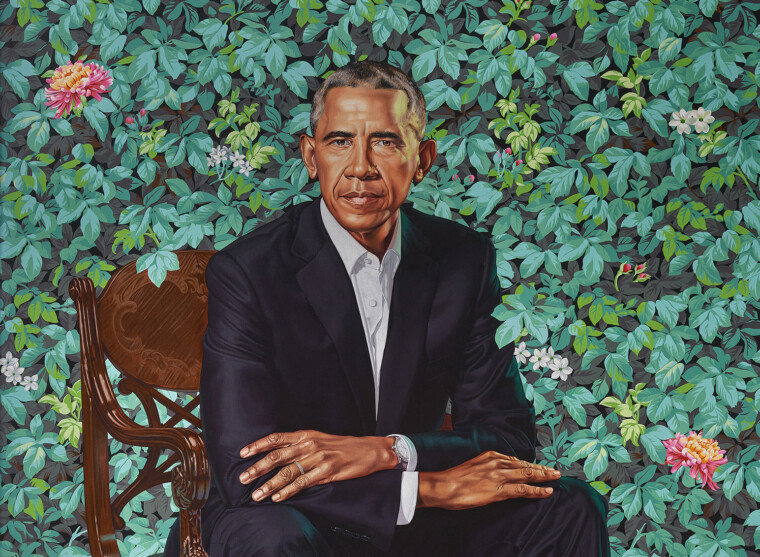
Kehinde Wiley, Portrait (detail), contemporary work. The artist's portraits have trended upward by approximately 15% year over year. Source: kehindewiley.com
That squeeze carries consequences. At the ultra-high end, liquidity and visibility tend to follow. Kehinde Wiley portraits have trended upward by roughly 15% year over year, and Julie Mehretu's layered abstractions have drawn estimates around $12 million. At entry level, emerging artists found through digital channels offer lower-stakes access. Between $500,000 and $2 million, confidence thins and inventory slows.
McAndrew's data shows 33% of dealers reported sales declines in 2025, while operating costs rose 5%, outpacing sales growth and inflation in New York and London. Margins narrowed. Galleries with annual turnover below $500,000 posted stronger growth than mid-tier peers, suggesting the market currently rewards either scale or nimbleness, not the territory between.
Women Artists Reach Parity (Sort Of)
One statistic stands out. Female artists reached 50% representation among primary market galleries in 2025, up from 35% across all dealers in 2018.
Sales tell a more complicated story. Women accounted for 37% of sales by value overall and 44% for primary galleries. The shift is structural, but valuation still lags representation.
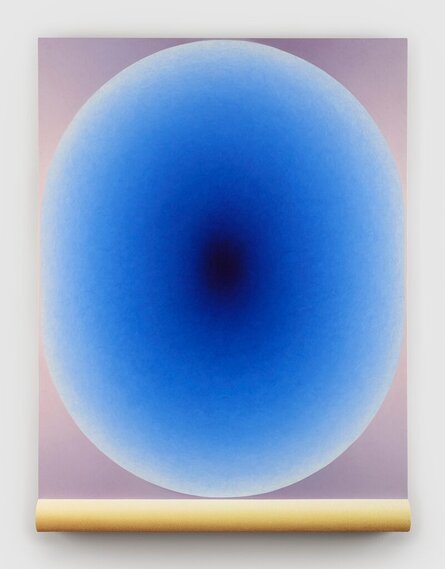
Loie Hollowell, pregnancy painting series. Works by the artist sold for $4.2 million at Phillips New York in May 2025. Source: www.artsy.net
Recent results underline the commercial momentum. Loie Hollowell's pregnancy paintings sold for $4.2 million at Phillips New York in May 2025. Cecily Brown's secondary market strengthened by roughly 15% year over year. Amy Sherald's portraits reached $2.8 million at Sotheby's in November 2025.

Amy Sherald, portrait work (detail). The artist's portraits reached $2.8 million at Sotheby's in November 2025. Source: www.culturetype.com
For collectors, the gap between visibility and pricing remains the point. Women now make up half the artists shown, yet generate just over a third of the value. The trajectory has been narrowing. Artists such as Charline von Heyl (represented by Hauser & Wirth and Maureen Paley, exhibited at Art Basel Miami Beach 2025) or Tschabalala Self (shown at Hauser's booth in Basel 2025) sit in a market moment where institutional attention can reprice quickly.
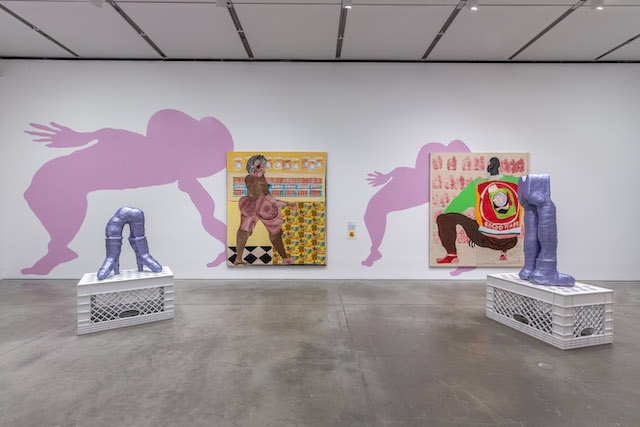
Tschabalala Self, installation view from Art Basel 2025. Shown at Hauser & Wirth booth, demonstrating institutional attention reshaping artist valuations. Source: artreview.com
The parity numbers also track a longer arc. Museums spent years correcting acquisition imbalances. Galleries adjusted. The market is now catching up.
Where the Money Went (and Where It Did Not)
New York dominated the high end. Autumn season activity concentrated in Manhattan auction rooms, with Christie's, Sotheby's, and Phillips capturing the most significant results.
The Klimt sale deserves context beyond the headline. The portrait of Elisabeth Lederer, rooted in Wiener Moderne and the Secession movement, accounted for much of the category's 47% surge. Without that single lot, the increase would read far more modestly.
Modern art's 9% rebound to $2.4 billion followed three consecutive years of decline. The report cites a landmark Frida Kahlo sale, without specifying the work, as part of the recovery, linking Mexican modernism to feminist narratives that continue to gain commercial traction.
In contemporary benchmarks, Julie Mehretu's process paintings, built from explosive lines layered over map-like grids, continue to set the ceiling for large-scale abstraction by living artists. Her 2024 work Black River, in ink and jacquard on canvas, appeared at Hauser & Wirth in 2025. At lower price points, Ruby Onyinyechi Amanze drawings have sold between $150,000 and $300,000, comparable to where Hollowell traded before her market accelerated. Amoako Boafo reached $1.1 million at Sotheby's in October 2025.
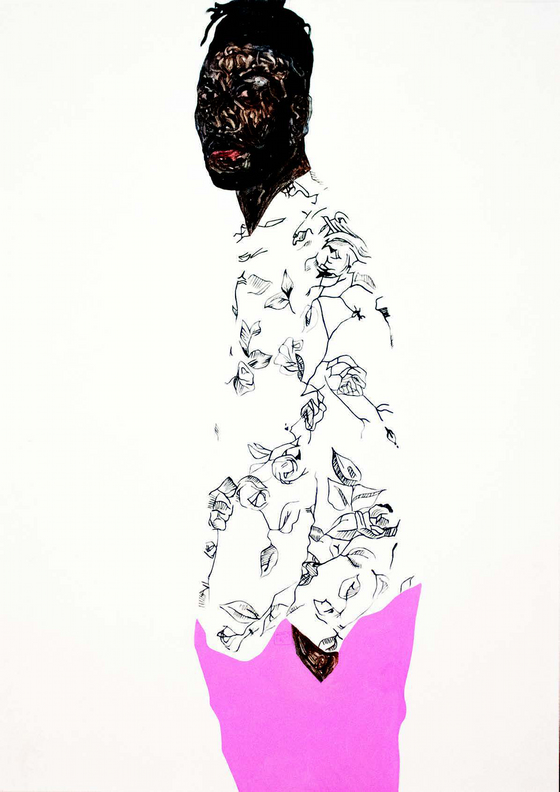
Amoako Boafo, contemporary work. The artist has reached auction prices of $1.1 million, reflecting strong secondary market momentum. Source: www.denverartmuseum.org
Online sales concentrated in mid-priced works but declined overall. Digital platforms drove discovery; fairs closed deals. Art Basel Miami Beach in December 2025 and Frieze London in October 2025 both reported stronger dealer results than the previous year.
What Collectors Should Actually Do
Confidence is returning, unevenly. The report finds 43% of dealers expect sales growth in 2026, up from 33% the year before. Among mid-tier auction houses, 48% anticipate gains.
Physical expansion continued despite rising costs. In 2025, 42% of announcements involved new spaces, compared with 25% closures. David Zwirner expanded in New York. Hauser & Wirth relocated in London. Smaller galleries with focused programs and lower overhead outperformed the squeezed middle: a reminder that size does not always track stability.
Authentication is becoming a sharper pressure point. The report notes growing concern around provenance verification in a digital market, with blockchain solutions emerging but not yet standardized. Female and emerging artist segments can carry lower authentication risk because of direct gallery relationships. Established estates can be more complex, and buyers should insist on Arts Economics-verified chains or comparable third-party documentation.
The data points to a simple positioning problem. Above $1 million, auctions offer liquidity and price transparency, and sales in this bracket rose 21% in value. Below $50,000, digital platforms can surface emerging artists; gallery relationships can then provide verification. In the middle, caution is warranted. This segment shows the weakest confidence and the slowest inventory movement.
Contemporary art's flat performance at $1.4 billion signals stability, not stagnation. The category absorbed economic headwinds and held. For collectors willing to hold through cycles rather than chase quick exits, contemporary remains defensible. The question now is where to stand on the barbell.
Download the full UBS Global Art Market Report here.