The Parking Lot Revelation
Westwood, Los Angeles, 1972. Larry Gagosian, 27 and newly graduated from UCLA with a degree in English literature, worked as a parking attendant near a garage. At the lot's edge, a street vendor sold posters marked up to $15 each. The math was obvious. So was the opportunity.

Westwood, Los Angeles, circa 1972, where Gagosian began his career selling posters from a parking lot adjacent to a garage.. Source: westfin.com
Gagosian began selling posters himself. No business plan. No talk of an art-world future. He was the son of Armenian immigrant parents; his mother had once appeared in an Orson Welles production, his father worked as a city accountant. Later, Gagosian would describe the pivot as a fluke.
Within months, he leased a small patio beside the lot and charged local craftspeople six dollars a day, plus ten percent of sales, to sell leather goods and trinkets. He called it the "open gallery," a name that was both literal and ambitious. Posters gave way to fine art prints by degrees, pulled along by young Hollywood collectors drawn to his window displays. Los Angeles in the early 1970s crackled with new buyers, and Gagosian, with no prior devotion to art (his interests ran to jazz, poetry, writing), became absorbed by the mechanics of desire and exchange.
By 1980, the hustle had a name and an address: the Larry Gagosian Gallery, focused on modern and contemporary art. The parking attendant had become a dealer. The instinct held. Watch what people want, then stand between them and the object.
New York and the Castelli Connection
New York was the next test, and it required a different kind of authority. Gagosian expanded east in 1985, opening in Chelsea with an exhibition of Pop art from the collection of Emily and Burton Tremaine. A statement of intent, delivered through borrowed prestige. The Tremaine name carried weight. The works carried prices.
The defining education followed. Between 1989 and 1996, Gagosian co-operated a Soho gallery at 65 Thompson Street with Leo Castelli, the dealer who shaped the careers of Jasper Johns, Robert Rauschenberg, and much of the New York School. The partnership brought proximity to artists such as Ellsworth Kelly, Roy Lichtenstein, and Bruce Nauman. It also revealed how blue-chip reputations are built, protected, and traded. Just as crucial, it clarified the balance between the primary market (selling directly from artists) and the secondary market (reselling among collectors).

Roy Lichtenstein's pop art works were among the artists Gagosian encountered through his partnership with Leo Castelli in SoHo.. Source: www.nationalgalleries.org
Traditional dealers made their names by nurturing artists, taking commissions on early sales, and waiting for values to rise. That model demanded taste, patience, and long relationships. Gagosian leaned hard in the other direction. He concentrated on the secondary market and positioned himself less as an artist's advocate than as a collector's peer, cultivating mega-collectors including David Geffen, Si Newhouse, and Charles Saatchi. The nickname "Go-Go" followed, tied to the speed of his flips.
The approach worked because it matched collector psychology. Rather than asking clients to gamble on the unproven, he offered trophies already validated by auction records and museum exposure, with the implied assurance that liquidity would be available later. The gallery became less a curatorial project than a marketplace for winners.
Empire by Architecture
Scale is visible before a single artwork appears. Eighteen galleries now span the United States, Europe, and Asia, housed in buildings by architects whose names signal institutional seriousness: Richard Meier, Jean Nouvel, Selldorf Architects, Caruso St John. More than 300 employees staff the operation. A publishing arm produces catalogues raisonnés and a quarterly magazine launched in 2012. Online viewing rooms extend the reach. The infrastructure reads like a museum network, built for commerce.

Gagosian's galleries worldwide are housed in buildings designed by renowned architects including Richard Meier and Jean Nouvel, signaling institutional seriousness.. Source: gagosian.com
That reach makes certain exhibitions possible. The 1988 Lichtenstein Picasso show and the 2009 survey of late Picasso works operated at museum quality, elevating the gallery's reputation while reinforcing the market value of the artists on view. Gagosian commissioned Cy Twombly in 2010 to create a permanent ceiling installation for the Louvre's Salle des Bronzes, a project that blurred patronage and publicity.

Cy Twombly, permanent ceiling installation, Louvre's Salle des Bronzes, 2010. A project that exemplified Gagosian's approach to blending patronage and publicity.. Source: www.nytimes.com
The roster tracks the same ambition. Living artists represented include John Currin, Theaster Gates, Titus Kaphar, Richard Prince, Jeff Koons, Ed Ruscha, and Takashi Murakami. The estate of Cy Twombly, who died in 2011, remains with the gallery. Each name carries artistic significance and market power, categories Gagosian has spent five decades proving are not always separate.
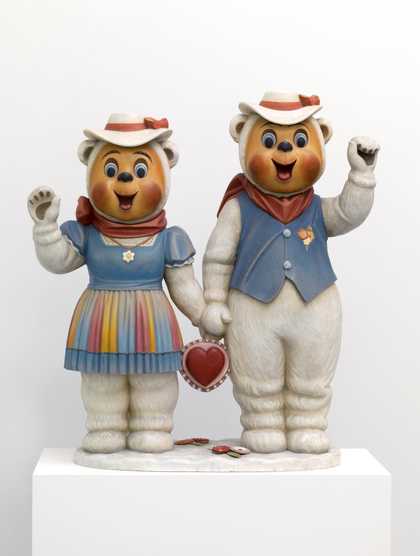
Jeff Koons is among the living artists represented by Gagosian, combining artistic significance with substantial market power.. Source: www.tate.org.uk
Institutional recognition followed. A Peabody Award arrived in 2006 for producing the documentary "American Masters: Andy Warhol." France awarded Gagosian the Chevalier de la Légion d'honneur in 2010 and the Ordre national du Mérite in 2015. The American Academy in Rome granted the Rome Prize for Visual Arts. Forbes included him among its "100 Greatest Living Business Minds" in 2017. Board roles at Jazz at Lincoln Center, NYU's Institute of Fine Arts, and the Getty's President's International Council formalized cultural authority.
What Collectors Should Understand
On May 10, 2022, Gagosian purchased Andy Warhol's "Shot Sage Blue Marilyn" for $195 million, the highest price ever paid at auction for a twentieth-century artwork. The sale distilled his method. Warhol died in 1987, yet the posthumous market for his work, especially the trophy pieces, was shaped in part by decades of resales, exhibitions, and strategic placements. The $195 million was not only a purchase. It was a validation of a market he had helped build.
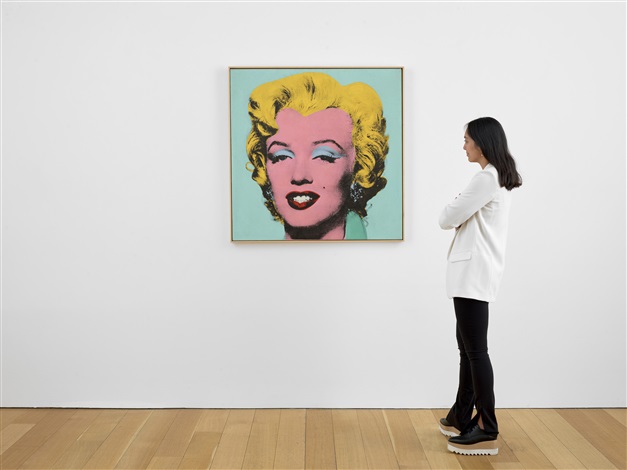
Andy Warhol, Shot Sage Blue Marilyn, 1964. Synthetic polymer paint and silkscreen ink on canvas. Sold at auction for $195 million in May 2022.. Source: www.artnet.com
Collectors considering Gagosian-represented artists, or works moving through his secondary market, should keep several realities in view. Pricing reflects not just artistic merit but overhead and market-making power. Premiums of twenty to fifty percent over comparable non-Gagosian works are common. Provenance matters intensely. The gallery publishes catalogues raisonnés for key artists, and documentation from these sources is crucial for authentication, particularly for Warhol, where posthumous fakes circulate widely.
The relationship, finally, is transactional by design. Larry Gagosian, the gallery's founder and sole owner, has described dealing as having a mercantile essence that rejects moral judgments on transactions. Collectors expecting loyalty or preferential access to primary works should calibrate expectations accordingly. The gallery serves those who buy, and buy significantly.
The Westwood parking lot is long gone. The six-dollar daily rent for patio space has become something else entirely. But the logic persists. Gagosian watched a vendor sell posters, saw the markup, and asked a simple question: why not? The art world, for better and worse, has been answering ever since.