The Commission That Wasn't
Judy Chicago doesn't apply for public art commissions. She's done it three times in six decades, and each time left a mark. So when a dealer urged her to propose a work for Google's renovation of the Thompson Center in downtown Chicago—her hometown, her namesake—she resisted. She was recovering from a long illness. She had work to finish. She knew better.
She did it anyway.
Her proposal: a terrazzo floor featuring a signature "Through the Flower" image, plus a design for the building's 17-story glass elevator shaft. Google approved it in fall 2025, with completion targeted for late 2027. Chicago, now 86, would collaborate with her husband Donald Woodman, a photographer with architectural training who has worked alongside her for decades. The Thompson Center is a Helmut Jahn landmark, a postmodern behemoth that Google purchased as a major Midwest hub. The company wanted warmth. A destination. Something, as Chicago puts it, that could lure remote workers out of their pajamas and into face-to-face encounters.
Instead, the project became a lesson in how not to work with an artist.
Google wanted an immediate site visit. Chicago and Woodman flew out on their own dime—no contract, no payment. They had already spent weeks preparing: studying the building's history and structure, poring over images online. That's their method. But Google seemed to expect an exact, frictionless translation of the original proposal, as if a rendering could simply be enlarged to monumental scale without testing, collaboration, or adjustment. Anyone who has ever moved a design from paper to space knows that's fantasy. Google, apparently, did not.
The architectural drawings Chicago needed were promised, then never delivered. Accurate dimensions followed the same pattern. At one point, Google placed what Chicago calls a "moratorium" on direct communication between her and the Chicago team; everything had to route through Gray Area, the firm managing Google's art projects. Delays stacked up. A contract didn't arrive until mid-November, and when it did, it "drastically limited" her creative control. Then came the decree that her rosette design should be shrunk into a decorative flourish—ornament, not statement.
Chicago had seen enough.
She walked.
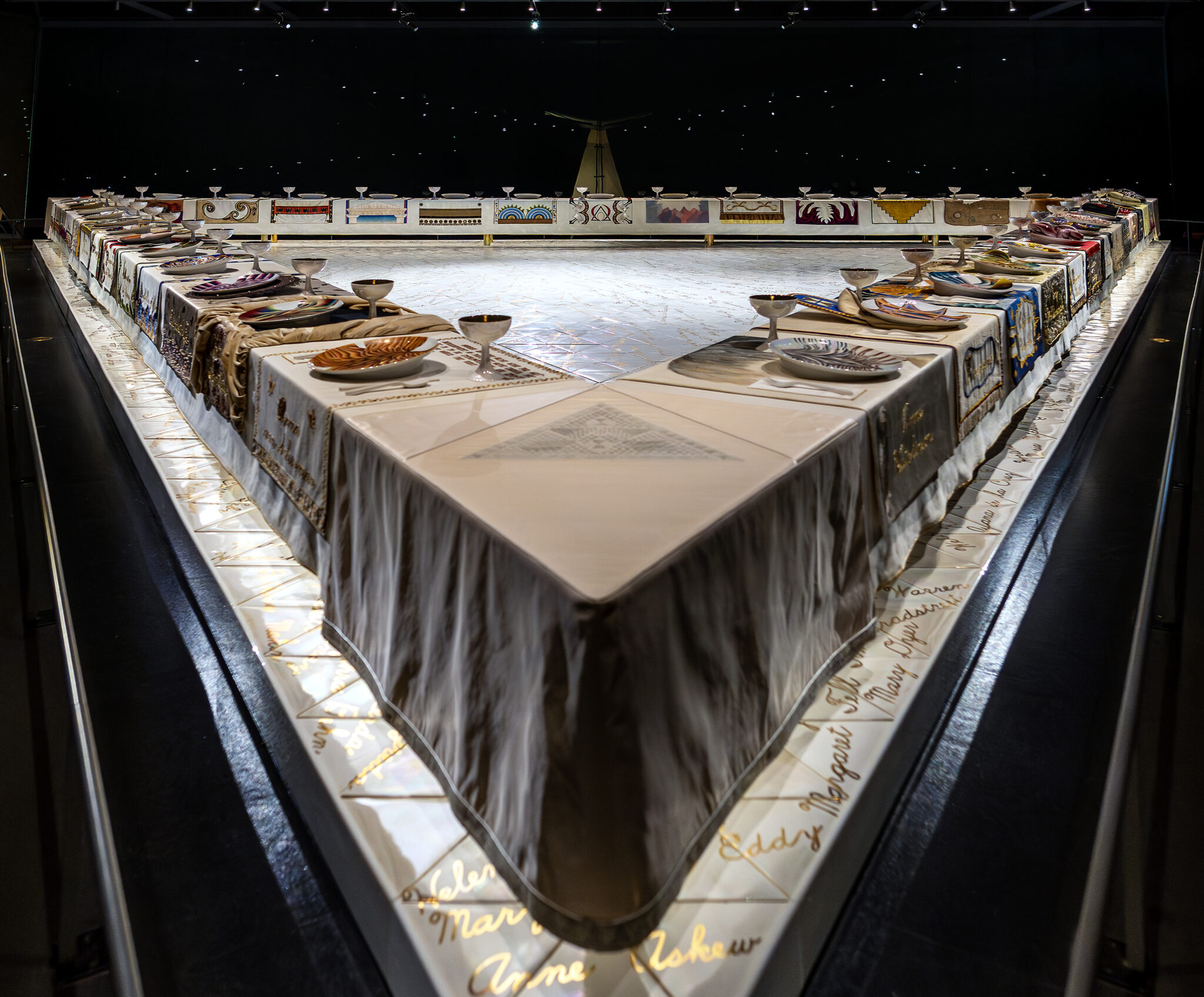
Judy Chicago, The Dinner Party, 1974–79, ceramic, porcelain, and textile, 1463 x 1463 cm (Brooklyn Museum; photo: Steven Zucker)
A Career Built on Walking Away
Chicago has made a career out of refusing to be reduced.
Born Judith Sylvia Cohen in 1939, she grew up in Chicago, studied at the Art Institute there, then moved to Los Angeles for graduate work at UCLA. The Southern California art scene of the 1960s was hostile terrain for women. She built her formal skills anyway, learning welding and pyrotechnics, while developing an abstract vocabulary that would later erupt into explicitly feminist imagery. In 1970, she legally changed her name to Judy Chicago, shedding her father's surname and her ex-husband's. Defiant. Funny. Perfectly timed for her solo show at California State College that year, where she debuted work featuring vaginal forms that would become her signature.
That same year, she founded the first Feminist Art Program at California State University, Fresno, the first of its kind in the country. Two years later, she and Miriam Schapiro launched a second program at CalArts, producing Womanhouse, a legendary installation in an abandoned Los Angeles building that turned domestic space into feminist critique. In 1973, she co-founded the Feminist Studio Workshop at the Woman's Building in L.A., offering courses in visual art, performance, video, and writing.
Then came The Dinner Party.
Created between 1974 and 1979, the installation honors 39 women from history with elaborate place settings arranged on a triangular table. It required hundreds of collaborators incuding ceramicists, needleworkers, researchers, and years of labor. When it debuted in 1979, it ignited controversy. Critics accused Chicago of essentialism, of reducing women to biology. Others hailed it as a monumental corrective to centuries of erasure. The work toured internationally, drawing massive crowds, before finding a permanent home at the Brooklyn Museum's Elizabeth A. Sackler Center for Feminist Art in 2007. It still accounts for roughly 20 percent of the museum's traffic.
She kept going. Birth Project (1980–1985) enlisted 150 needleworkers to execute designs celebrating childbirth. Holocaust Project (1985–1993), created with Woodman, confronted genocide through painting and photography. The End: A Meditation on Death and Extinction premiered in 2019. She has taught at universities across the country, sponsored an art education collection at Penn State, and collaborated with Dior on a massive 250-foot goddess figure for Maria Grazia Chiuri's 2020 haute couture show in Paris.
She is 86. She has nothing left to prove.
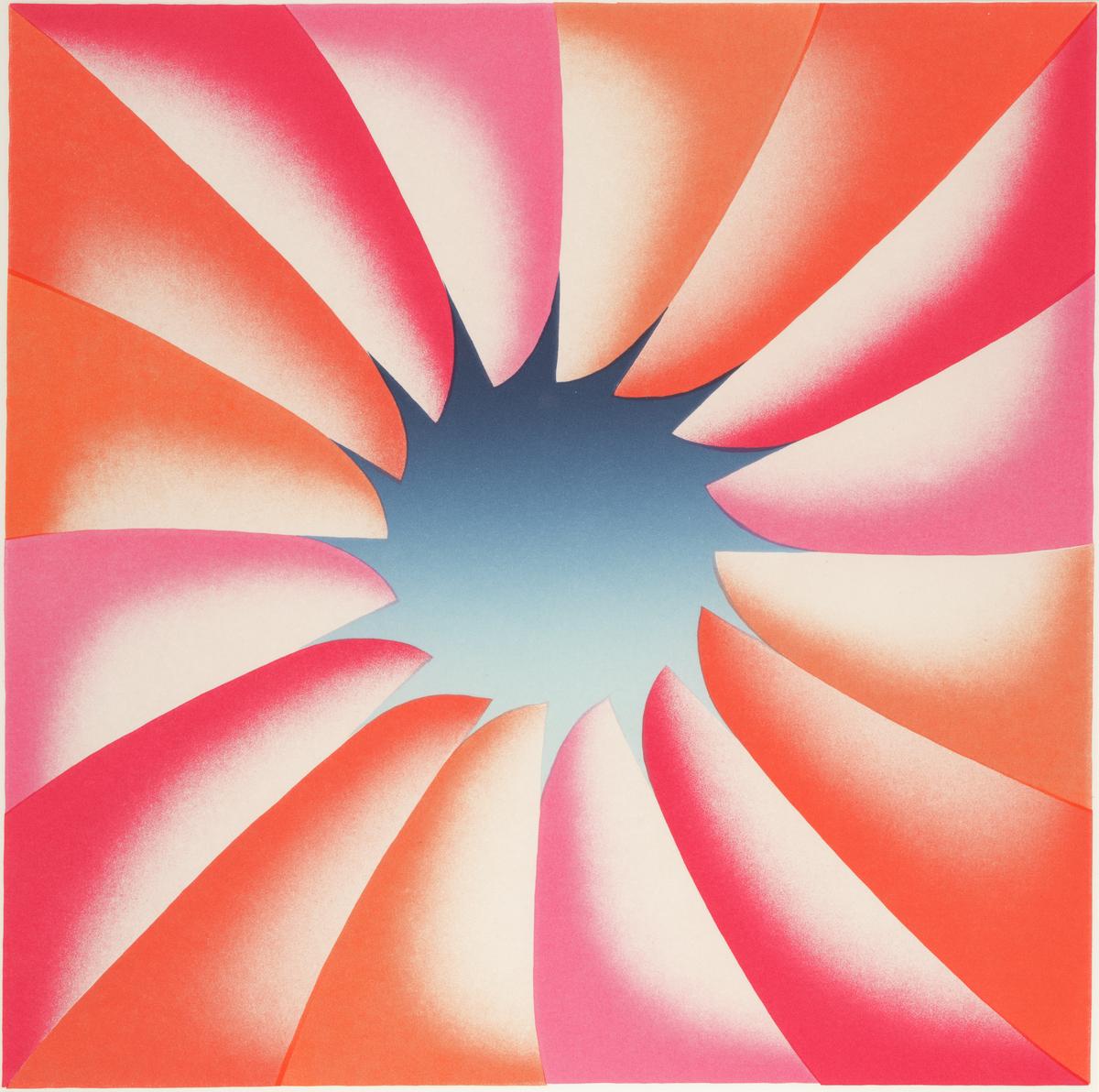
Judy Chicago, Through the Flower #3, 1972
The Market Problem
Judy Chicago's market still doesn't match her stature.
She has a permanent installation at a major American museum. Her retrospective at the de Young in San Francisco drew critical acclaim. She's represented by Jessica Silverman Gallery and has shown at institutions worldwide. The Dior collaboration alone reached millions. Yet auction results remain thin, and prices haven't climbed the way they have for male peers of comparable influence.
Some of this is structural. Chicago's most important works are collaborative, labor-intensive, and often site-specific. The Dinner Party can't be sold; it belongs to the Brooklyn Museum. The Birth Project pieces are dispersed across public collections. Her "Atmospheres" series—fireworks performances staged in California landscapes between 1967 and 1974—exists primarily as documentation. The market prefers objects that can be hung on walls and flipped at auction. Chicago's practice resists that logic.
And some of it is the sexism she has fought for decades. When Beverly Hills considered acquiring one of her outdoor sculptures, work comparable to pieces the Whitney had already purchase, a male city councilor publicly questioned whether it was worth the asking price. This was long after The Dinner Party had become canonical. The doubt lingers.
For collectors, that mismatch creates both risk and opportunity. Chicago's drawings, prints, and smaller paintings do come to market, often at prices that would seem modest for an artist of her historical importance. A collector with patience and strong gallery relationships can acquire significant work without the frenzy surrounding certain male artists of her generation. But authentication matters. Provenance matters. Chicago has been working for sixty years, and record-keeping on early pieces can be uneven. Her studio and gallery maintain documentation, but buyers should insist on paper trails before committing serious money.
The Google fiasco might not help her market in the short term, but it does sharpen what has always been true about Chicago: she won't be diminished. She walked away because she was treated like a decorator, not a visionary. That integrity has costs. It also has value.
What Collectors Should Know
Collecting Judy Chicago means learning to see the difference between the familiar and the exceptional.
The "Through the Flower" imagery, radiating, petal-like forms that suggest both botanical and anatomical openings, remains her most recognizable motif. The strongest examples carry luminous gradients, the kind that gave her Google proposal its power. Those transitions are hard to execute well; weaker works collapse into simple blocks of color. Look for pieces where the shifts feel inevitable, where the colors seem to breathe.
Her painted porcelain works from the late 1970s, exhibited at the Ruth Schaffner Gallery in Los Angeles in 1977, depict "six stages of women's aspiration." They're rare. They connect directly to The Dinner Party's ceramic vocabulary and to the educational framework Chicago embedded in the original exhibition. If one surfaces, pay attention.
Works on paper, drawings and studies, offer entry points at lower price levels. The Brooklyn Museum holds extensive Dinner Party documentation, but preparatory drawings occasionally appear. Provenance linking a work to a specific project adds value and historical weight.
Condition matters more than usual with Chicago because of the materials involved. China paint, embroidery, and mixed-media pieces require careful conservation. Ask about storage history. Ask about light exposure. If a gallery can't answer, find one that can.
And be clear about what you're buying into. Chicago's market may never explode the way some collectors hope. Her place in art history is secure. The Dinner Party isn't going anywhere. Neither is her influence on generations of feminist artists who followed. You're not buying hype. You're buying a legacy.
At 86, Judy Chicago is still making work, still refusing compromises, still walking away when the terms aren't fair. The Google debacle will fade. Her work will endure.