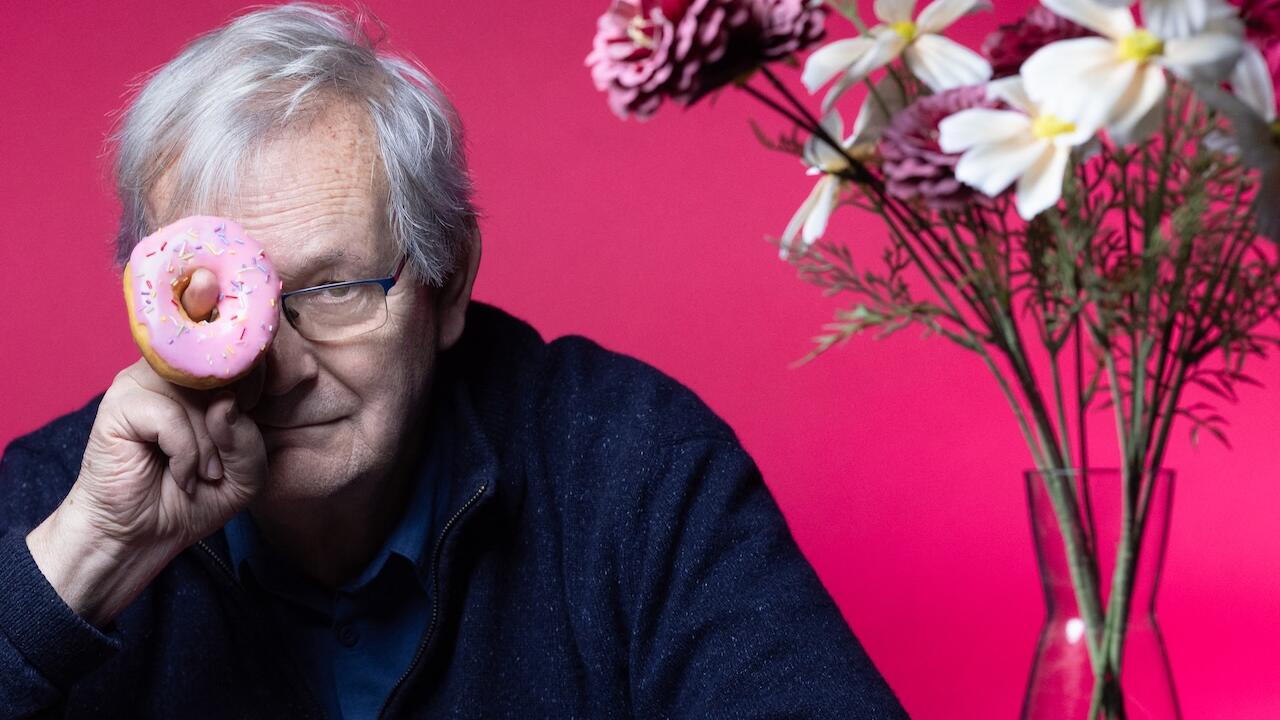
The photographic world mourns the passing of Martin Parr, whose incisive lens captured the idiosyncratic tapestry of British life with unparalleled clarity, at the age of 73. A relentlessly productive artist, Parr’s oeuvre encompassed over 100 photobooks, extensive exhibitions in prestigious global institutions, and a well-deserved CBE bestowed in 2021 for his profound contributions to photography. Born in Surrey, UK, in 1952, Parr’s photographic journey began in adolescence, significantly influenced by his grandfather, the amateur photographer George Parr. Reflecting on his formative years, Parr once conveyed to The Guardian his unwavering conviction: ‘I knew I would be a photographer from the age of 13, 14, and I knew what was good even then. I was obsessive about photography.’

British photographer Martin Parr poses during the press preview of 'Only Human' (2019) at the National Portrait Gallery, London. Courtesy: Tolga Akmen/AFP via Getty Images
While formal academic pursuits presented challenges for Parr, his tenure studying photography at Manchester Polytechnic (now Manchester Metropolitan University) in the early 1970s proved foundational. It was there he encountered his future wife, the writer and researcher Susie Parr, and forged enduring friendships with notable photographers including Daniel Meadows and Brian Griffin. Even in his early monochromatic works, Parr’s innate talent for portraiture—and his fascination with marginal figures in British society—was self-evident. His inaugural documentary series, ‘Prestwich Mental Hospital’ (1972), undertaken while still a student, saw him granted unprecedented access to a psychiatric institution, yielding remarkably poignant and playful images of both staff and patients. Subsequent series from this period included ‘Yates Wine Lodge’ (1982–83), chronicling patrons in a chain of public houses, and ‘Bad Weather’ (1981), which depicted life on the rain-swept streets of Britain and Ireland.

Martin Parr, _GB. England. New Brighton_, 1985, from 'The Last Resort', 1983–85. Courtesy: © Martin Parr/Magnum Photos, Galerie Clémentine de la Féronnière, Paris
The Embrace of Color and the Unflinching Gaze of ‘The Last Resort’
Drawing influence from pioneering American color photographers such as William Eggleston and Stephen Shore, Parr irrevocably transitioned to shooting with color film in the 1980s. He often cited his fascination with vibrant, saturated hues as being ignited by the distinctive postcards of photographer John Hinde, which he encountered while working at Butlin’s—a chain of British seaside resorts—in the early 1970s. As he provocatively stated to Magnum Photos, ‘I want the pictures to be bright and cheerful. Well, they may not be cheerful, but certainly bright.’ It was ‘The Last Resort’, first exhibited in 1986 at London’s Serpentine Gallery, that propelled Parr into widespread recognition. This seminal series captured working-class holidaymakers in the Merseyside seaside town of New Brighton, exposing their sun-drenched realities with an unvarnished honesty. Highly polarizing, these unreserved images frequently drew criticism as exploitative or even cruel—hasty condemnations often fueled by the visceral shock of his unfiltered gaze rather than a deeper understanding of his intent, a dynamic that would accompany Parr throughout his illustrious career.

Martin Parr, _Switzerland. Alps. The Matterhorn_, 1990. Courtesy: © Martin Parr/Magnum Photos, Galerie Clémentine de la Féronnière, Paris
Global Observations and Curatorial Vision
While Parr would eventually ascend to the presidency of Magnum Photos from 2013–17, his journey to widespread acclaim was a deliberate ascent; his initial admission to Magnum was granted by the slimmest of margins among his peers. Writing for this magazine in 1998, Neal Brown astutely observed, ‘Many photographers publicly dislike Parr because he shamelessly reveals the predatory basis of certain aspects of documentary photography, which usually prefers to consider itself in terms of dignified social concern, or the neutralities of reportage.’ Although celebrated for his portrayals of the British Isles, Parr’s wanderlust led him to extensively document holiday resorts and tourist locales across the globe. In a 2021 interview with Blind Magazine, he articulated his approach: ‘You learn a lot about a country from its beaches: from one culture to the next, it is one of the few public spaces where you come across the quirks and eccentricities that characterize a nation.’

Martin Parr, _Seagaia Ocean Dome, Miyazaki, Japan_, 1996. Courtesy: © Martin Parr / Magnum Photos; Jeu de Paume, Paris
Parr’s expansive curiosity also extended to curatorial endeavors throughout his career, where he organized solo exhibitions for photographers he deeply admired, such as David Hurn and David Goldblatt, alongside numerous group exhibitions dedicated to British photography and life. These included ‘Strange and Familiar’ (2016), a visionary exploration at the Barbican in London and Manchester Art Gallery, which showcased how international photographers had depicted the UK since the 1930s through 250 compelling images. Additionally, he lent his discerning eye as guest curator for ‘The New Typologies’ exhibition at the 2008 New York Photo Festival and ‘New Documents’ at the 2010 Brighton Photo Biennale, and served as guest artistic director for the 2004 Rencontres d’Arles festival of photography. At the time of his passing, Parr was meticulously preparing a major retrospective entitled ‘Global Warming’ at the Jeu de Paume in Paris, scheduled to open on January 30, 2026. Spanning five decades of his practice, this exhibition promises to reveal Parr’s work as an indirect, yet potent, critique of ‘the ravages of mass tourism, the prevalence of car culture, our dependence on technology, consumer excess, and even our ambivalent relationship with the living world.’ His legacy, a testament to his unique vision, will undoubtedly continue to inspire and provoke.