From Photocopied Zines to the Musée Picasso
Raymond Pettibon was not supposed to end up beside Pablo Picasso. Born in Tucson in 1957, the Los Angeles artist spent the early 1980s photocopying zines in his brother's garage, designing album covers for Black Flag, and selling ink drawings to anyone with twenty dollars and a tolerance for blasphemy. Now his work occupies the Musée National Picasso in Paris, where Raymond Pettibon: Underground runs through March 1, 2026. Seventy drawings and ten original fanzines sit alongside Philip Guston's late figurative paintings in a parallel exhibition titled The Irony of History.
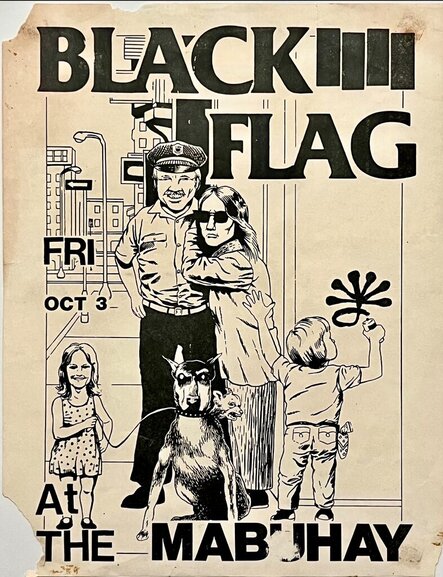
Raymond Pettibon, Black Flag album cover design, 1980s. Courtesy the artist. Source: www.artsy.net
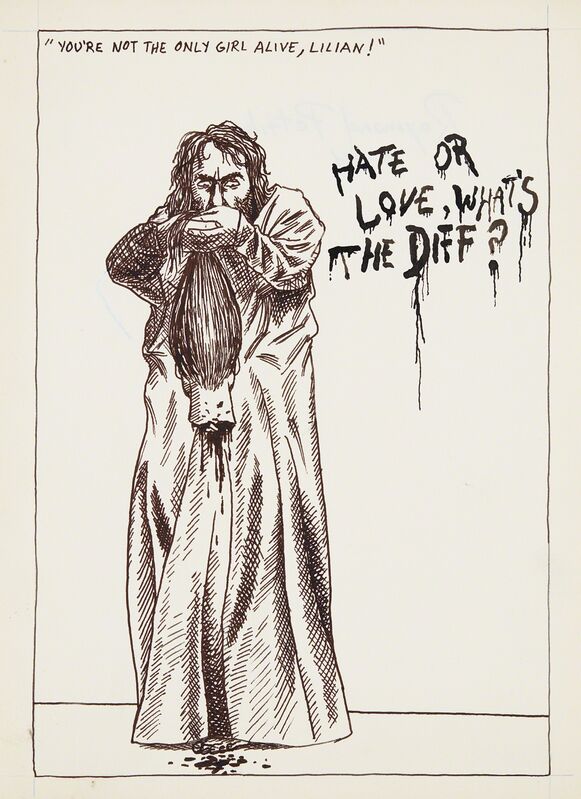
Raymond Pettibon, untitled drawing, ink on paper, 1980s. Courtesy the artist and Regen Projects. Source: www.artsy.net

Installation view, Raymond Pettibon: Underground, Musée National Picasso, Paris, 2025–2026. Source: francetoday.com
The pairing is deliberate. Guston abandoned Abstract Expressionism in the 1970s to paint cartoonish Klansmen, cigarettes, and disembodied legs, scandalizing the art world with images that felt too direct, too ugly, too confrontational. Pettibon works in a related register. Oversized sheets of paper fill with obsessive handwriting, gothic figures, surf Nazis, atomic explosions, and literary references ranging from Henry James to Edgar Allan Poe. The Picasso curators describe his universe as "ironic and disturbing," a phrase that captures the discomfort without accounting for its stakes.
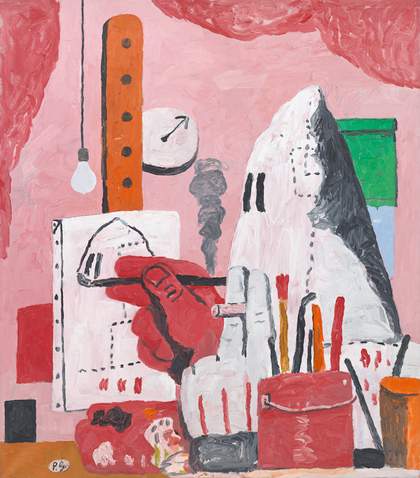
Philip Guston, Untitled, 1974. Oil on canvas. Courtesy the estate of Philip Guston. Source: www.tate.org.uk
What distinguishes Pettibon from other artists shaped by punk is his refusal to simplify. A single drawing can hold a baseball player, a mushroom cloud, a quotation from Faulkner, and an obscene joke, all rendered in ink with the confident sloppiness of someone who has made tens of thousands of similar works. The drawings resist easy consumption. They photograph badly. In person, they reward sustained attention, revealing political satire and cultural critique that contemporary viewing habits rarely encourage.
For collectors who acquired Pettibon works during his zine years or early gallery shows, the Picasso exhibition signals a shift in institutional category. No longer punk ephemera, the work is treated as art-historical material, positioned for dialogue with twentieth-century masters.
The 2025 Exhibition Calendar and Its Market Implications
Pettibon's institutional momentum became a schedule in 2025. Exhibitions arrived in quick succession, and the framing tightened around art history rather than subculture.
The year brought an unusually concentrated run: The Seven Deadly Sins and The Seven Heavenly Virtues at Kebbel Villa in Schwandorf, Germany (February through April 2025), paired his moral investigations with painter John Newsom; HK Contemporary in Hamburg presented new works through May 2025; and the Langen Foundation in Düsseldorf included him in Drawing, Painting, Sculpture, Photography, Film, Video, Sound: Ringier Collection 1995–2025, a survey running through October 2025 that positions his drawings alongside Jenny Holzer, Barbara Kruger, and Jordan Wolfson.
The oddest entry was 52W HARDWAY at David Zwirner's Walker Street space in New York (September 26 through October 11, 2025), a collaborative exhibition with professional wrestler Darby Allin and artist Charlie Ramone. The show underscored Pettibon's ongoing interest in extreme subcultures and physical spectacle, the same territory he explored forty years ago when documenting hardcore shows and designing flyers for bands whose members routinely bled on stage. A professional-wrestling collaboration in 2025 reads as a refusal of respectability, even as museum walls close in.
David Zwirner, Pettibon's primary gallery alongside Regen Projects in Los Angeles, presented his work at Art Basel Miami Beach (December 2025) and Art Basel Paris (2025). The art-fair circuit compresses decision-making, and Pettibon remains legible at speed. Dual representation by two major galleries signals active market engagement and institutional confidence. It also reflects a practical reality: he produces prolifically, and the market has absorbed significant volume without collapsing prices.
Collectors tracking these exhibitions should watch the curatorial language. Museums increasingly place Pettibon within lineages such as Guston, the Pictures Generation, and Los Angeles Conceptualism, rather than punk, zines, and DIY aesthetics. That reframing shapes scholarship, and scholarship shapes valuation.
Auction Performance and the Question of Period
Secondary-market performance has stayed steady. The numbers are blunt: Pettibon drawings trade from $100,000 to $1.5 million depending on period, subject matter, and scale.
A 2023 Phillips sale of No Title (And what...) from 1987 achieved $1.3 million, reflecting collector appetite for early punk-era works that document his formative visual language. The date matters. It lands after the Black Flag collaborations established his reputation, and before institutional recognition began to recalibrate how the work is read.

Raymond Pettibon, No Title (And what...), 1987. Ink on paper. Sold Phillips, 2023. Source: www.sothebys.com
Period, however, remains the market's unresolved problem. Pettibon's signature style emerged in the early 1980s and has held remarkably steady for four decades. The handwriting persists. The ink washes behave the same way. The subjects recur obsessively: baseball, surfing, politics, sex, literature. Consistency helps authentication, but it complicates valuation. A 2024 drawing can look uncannily close to a 1984 drawing.
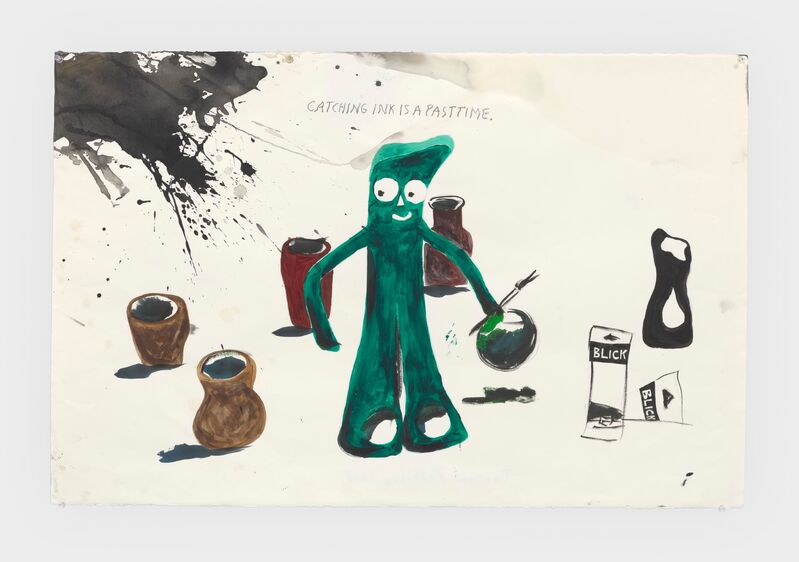
Raymond Pettibon, untitled drawing, ink on paper. Courtesy the artist and David Zwirner. Source: www.artsy.net
Conventional logic assigns premiums to early works because they record invention rather than repetition. Pettibon complicates that logic. The drawings operate like diary entries, their meaning accruing through volume and variation rather than singular masterpieces. One drawing reads as provocation. Twenty begin to map a mind moving through decades of American dysfunction.
Authentication is relatively straightforward given major-gallery representation and extensive exhibition history. Works acquired directly from David Zwirner or Regen Projects carry clean provenance. Secondary-market purchases benefit from the artist's distinctive hand, difficult to forge convincingly because the apparent sloppiness depends on control.
What Separates Good Examples from Great Ones
As museums elevate Pettibon, collectors face a sharper question. Which works will carry the most weight when the dust settles?
Scale matters more than many collectors admit. Pettibon's drawings range from notebook size to wall-spanning expanses of paper. The largest works, some exceeding eight feet in any direction, create a physical encounter that smaller drawings cannot. Handwriting turns architectural. Ink washes become atmospheric. Literary fragments feel environmental rather than illustrative. Curators gravitate to that impact, and the market tends to follow.
Text density is another fault line. Some drawings offer a single phrase. Others carry hundreds of words, handwriting that spirals, fragments, and contradicts itself across the surface. The densest examples function as visual literature, demanding reading as much as looking. They hold up because they keep yielding.
Subject matter stratifies demand. Surfing imagery, a Pettibon signature since the 1980s, draws consistent interest, as do explicitly political works addressing American militarism, presidential politics, and cultural violence. The baseball drawings sit in a middle tier, beloved by some collectors and passed over by others. Sexually explicit works remain the most volatile category, attracting specialized buyers while limiting institutional exhibition possibilities.
Condition requires vigilance. Pettibon works on paper, using inks that can fade under improper lighting and papers that yellow without archival framing. Storage and display history should be verified before acquisition; museum-quality conservation is not optional. A faded Pettibon loses not only visual intensity but market value. The work depends on the crispness of black ink against pale paper.
The 2025 and 2026 exhibitions make one point unavoidable. Pettibon's market no longer depends on punk nostalgia or subcultural credibility. The work now sits inside broader conversations about American art, political imagery, and the traffic between high and low culture. Collectors holding strong examples from any period stand to benefit from that reframing, provided they recognize what institutional validation actually changes: not just prices, but the terms through which future audiences will encounter the work at all.