What the Shadows Know
Shadows did it. I'd seen Asawa's looped-wire sculptures before—hanging in photographs like exotic seed pods, like deep-sea creatures caught mid-pulse. But photographs lie. They flatten. They erase the shadows.
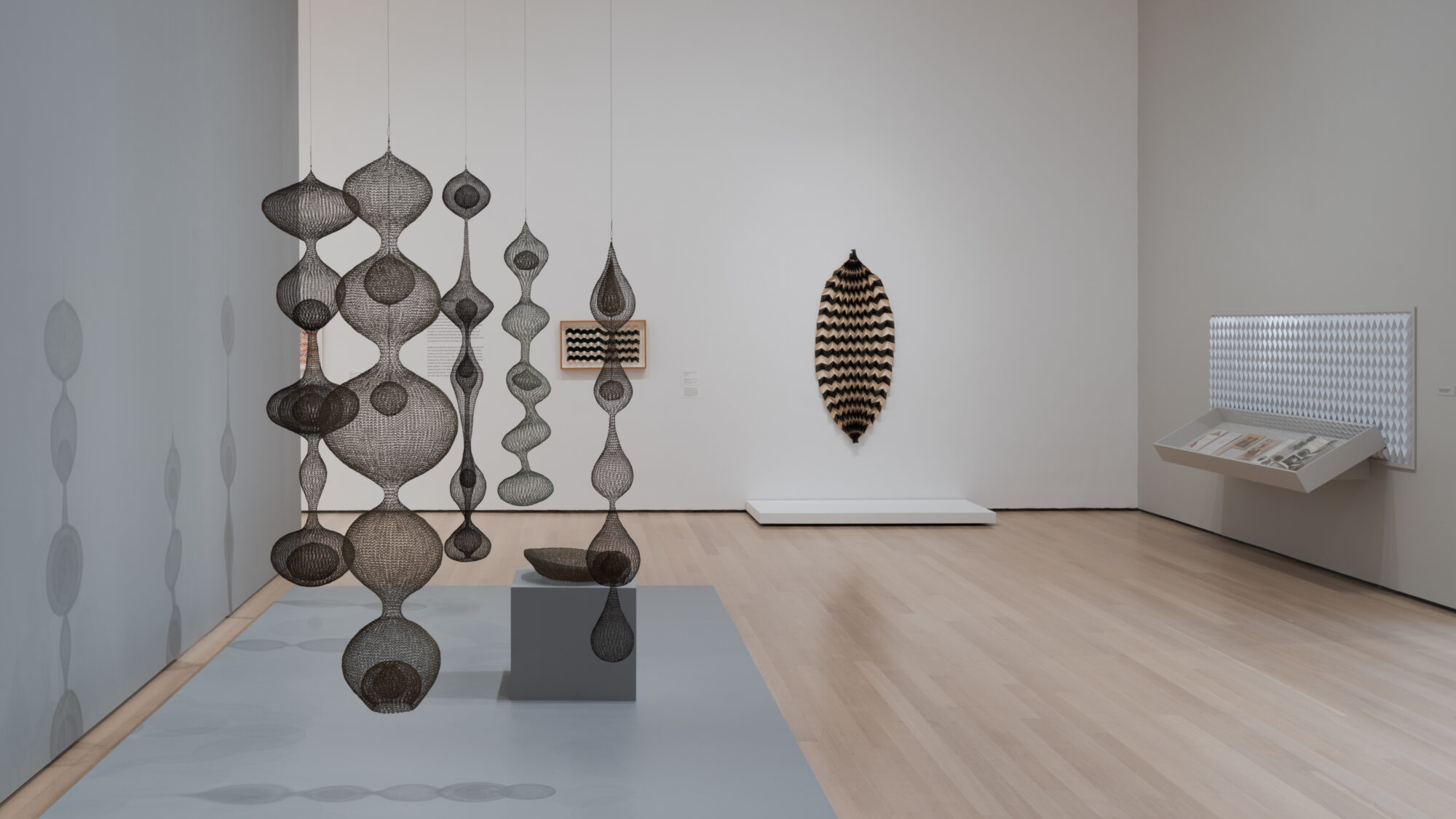
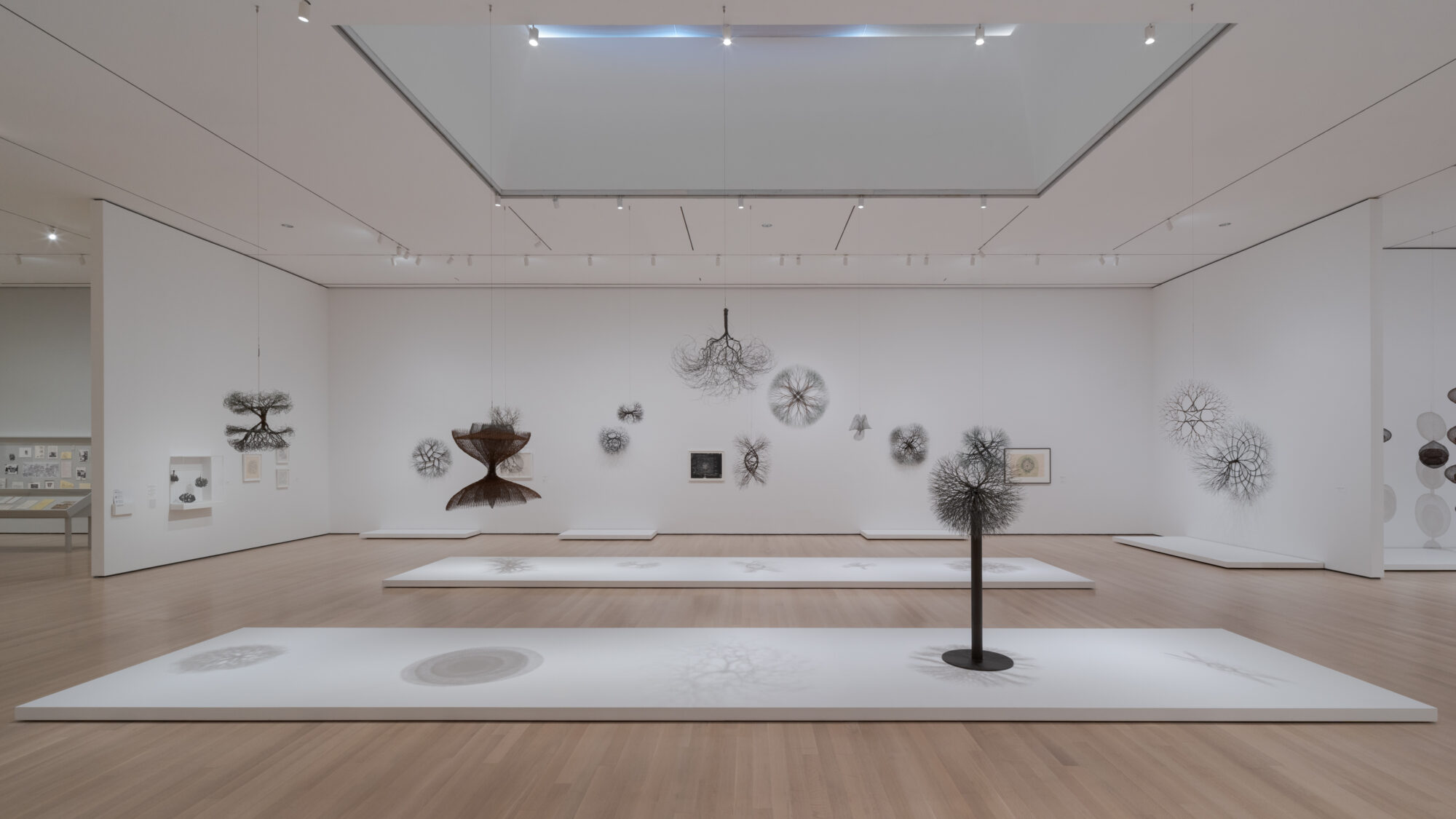
At MoMA, where Ruth Asawa: A Retrospective occupies 16,000 square feet of the sixth floor through February 7, 2026, the sculptures float above white catwalks, lit from above so each piece throws a second self onto the floor. The doubles don't behave. An elongated form with an oblong head casts a shadow with a round belly and a shortened neck. Another character entirely. Asawa knew. The shadows aren't accidents; they're dimensions—proof that one thing can contain infinity.
I walked the exhibition three times. The plan is continuous, every wall circumnavigable, and there's no wrong turn. You drift from her experiments with nature into a room devoted to her advocacy for arts education, then loop back, the first room changed by what you've just seen. The curators—Cara Manes at MoMA and Janet Bishop at SFMOMA—built the show the way Asawa built her sculptures: a continuous form within a form, inside and outside at once.
This is the largest exhibition MoMA has ever dedicated to a woman artist. That fact lands differently depending on how you take it—overdue to some, overcorrection to others. I stopped caring about the statistic. The work doesn't need institutional charity. The sculptures, the drawings, the folded paper constructions zigzagging on the wall like architectural origami—they hold their own against anything in MoMA's permanent collection.
SFMOMA's version drew 285,000 visitors and pushed August attendance to pre-pandemic levels for the first time. New York will likely surpass those numbers. The question for collectors isn't whether Asawa deserves this moment. It's what you missed while everyone was looking elsewhere.
The Education of Ruth Asawa
Her biography reads like a series of closed doors.
Born January 24, 1926, in Norwalk, California, the fourth of seven children on a truck farm. Parents: Japanese immigrants. Sixteen years later, on March 27, 1942, Executive Order 9066 sent her family to the Santa Anita Assembly Center—a racetrack in Los Angeles where they slept in horse stalls—before transfer to Rohwer Relocation Center in Arkansas for sixteen months.
At Rohwer, she took art classes from interned Disney animators. She graduated high school there. She enrolled at Milwaukee State Teachers College, completed all her coursework, and was denied her degree and teaching credential because no school would accept a Japanese American student teacher. The racism was explicit and documented.
Black Mountain College opened what the rest of the country refused. The experimental school in North Carolina admitted women and people of color when most institutions wouldn't. She arrived in 1946 on a church loan from Hawaii and stayed three years, studying under Josef Albers and Buckminster Fuller, alongside peers like Ray Johnson and Hazel Larsen Archer. The Bauhaus influence—Albers's insistence on material integrity, on letting substances speak their own language—stayed with her.
Then Mexico. In 1947, traveling through Toluca, she watched villagers weave baskets using a looped-wire method. Something clicked immediately. Back at Black Mountain, she began translating that technique into sculpture, crocheting industrial wire into forms that were inside and outside at once. By 1948, she had made her first looped-wire work.
She married architect Albert Lanier—a white man, in a union both families opposed—on June 10, 1949. They moved to San Francisco. She raised six children between 1950 and 1959 while working in a home studio. Her first New York solo show came at Peridot Gallery in 1955. By the early 1960s, she had commercial success. None of this was supposed to happen to a Japanese American woman who had been incarcerated, denied her degree, and spent her twenties in experimental poverty. She made it happen anyway.

Rafu Shimpo
The Work Itself
Start with the wire if you want. You won't end there.
The looped-wire sculptures are miraculous, but they're not the whole story. MoMA's 398 objects reveal an artist who couldn't stop investigating, who treated every material as a question demanding an answer.
Early oil-and-watercolor works from Black Mountain show bulbous forms that anticipate her later silhouettes, overlapping gently as if nuzzling. The thin paper buckles under the pigment's weight, straining to hold her vision. In "Figures on Green" (c. 1947–48), eight rounded figures lift their arms in various states of elongation and compression, pressing against the masonite surface. She was already searching for a dimension painting couldn't provide.
The paperfolds from 1951 find it. Zigzagging on the wall, they turn flat paper into architectural space through crease and fold alone. One resembles a giant seed pod, the folded paper and organic form alike labyrinths of intricacy and possibility. The curators carved that same pleated pattern into one exhibition wall, a reminder that in Asawa's world, everything folds into everything else.
By the 1960s, she had begun the tied-wire sculptures. Same thin wire as the looping works, but she abandoned the continuous skin. As many as 1,000 individual pieces radiate from a central stem, forming tree-like structures that branch outward like dendrites or roots or neurons. They're fractal—exploding rather than containing. Beginnings and endings at once.
She experimented with electroplating—electric currents and acid baths transforming surfaces. She sculpted in wood, clay, bronze. She made baker's-clay cast masks with schoolchildren for her public commissions, including the Hyde Street fountain (1968), where 200 students molded iron-cast images of San Francisco. The city called her "the fountain lady." She founded what became the Ruth Asawa San Francisco School of the Arts, which opened in 1982 and was renamed for her in 2010.
The MoMA show gives her civic work and arts education advocacy a room of its own—something the SFMOMA version underplayed. It matters. She didn't separate living from making. "Doing is living," she said. "That is all that matters."
What Collectors Should Understand
The market has already moved. MoMA will move it again.
Ruth Asawa's market has transformed since her death in 2013. Average prices for looped-wire sculptures rose roughly 400 percent between 2015 and 2024, climbing from $200,000–$500,000 to $2 million and beyond. The retrospective will accelerate this. Expect 2026 auction highs to breach $5 million for prime examples.
Yet the real shift isn't numerical. For decades, critics treated Asawa's Japanese heritage as the skeleton key to her work, framing the sculptures as ethnically legible—as if the looping wire spoke a language her internment history could decode. Reductive at best, racist at worst, that reading kept her outside the modernist canon: an interesting regional figure, not a major artist.
The retrospective corrects the record. It places Asawa within postwar abstraction, craft-modernist innovation, and feminist material practice. The comparisons now are to Lenore Tawney, Sheila Hicks, Eva Hesse, Lygia Clark—artists whose markets range from $500,000 to $5 million and climbing. Asawa belongs in that conversation.
For collectors, the practical considerations: David Zwirner handles the estate and offers primary market access. Condition matters—check for wire oxidation or fraying. Large hanging works command premiums, but the tied-wire sculptures and bronzes offer entry points under $1 million that may appreciate faster as the market catches up to institutional recognition. Authentication runs through the Ruth Asawa Foundation; demand certificates of authenticity and provenance documentation, particularly for smaller works where fakes occasionally surface.
The deeper consideration is what you're buying. Asawa spent her twenties incarcerated by her own government, denied her education by explicit racism, turned away at every institutional door. She made work anyway—every day, for decades. She transformed industrial wire into forms that toggle between anthropomorphic and alien, deep-sea and celestial, interior and exterior. She cast shadows that don't match their sources, yet somehow complete them.
You can acquire the object. The shadows come free.