Ruth Asawa: A Retrospective at MoMA
On view through February 7, 2026
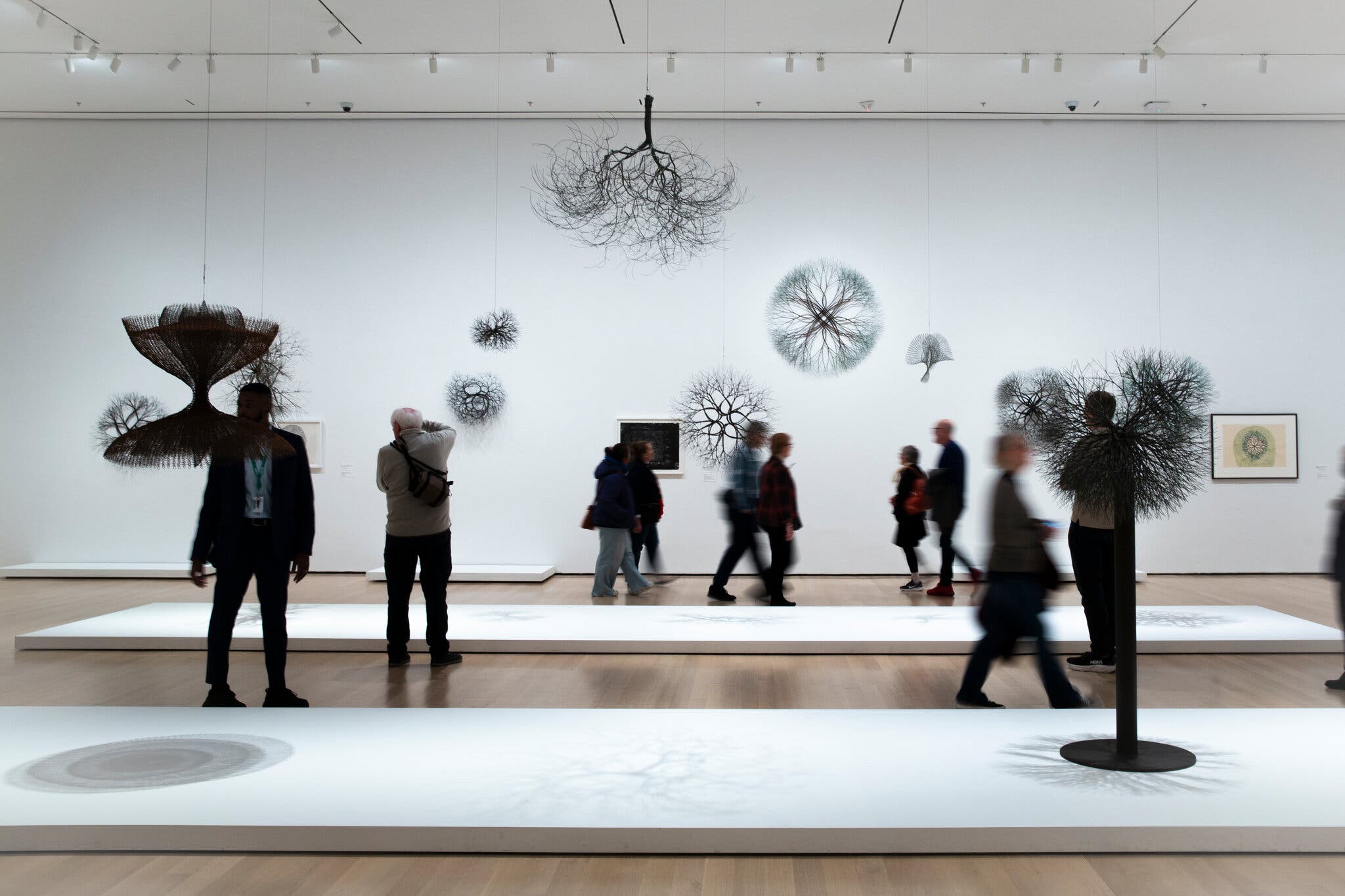
The Museum of Modern Art presents a commanding retrospective of the artist Ruth Asawa (1926–2013), whose prolific career, spanning from the late 1940s to the early 1990s, was primarily defined by her innovative work in industrial wire. Curated by Cara Manes (MoMA) and Janet Bishop (San Francisco Museum of Modern Art), the exhibition meticulously chronicles Asawa's journey through 398 works and archival documents.
The Genesis of Form: Materials and Technique
Asawa's distinctive looping technique emerged in 1947, inspired by an observation of wire basket-weaving in Toluca, Mexico. Utilizing commercial-grade industrial wire, she developed a continuous, crocheted method to construct her iconic hanging sculptures. These ethereal forms, often identified by their lobe count rather than formal titles, are characterized by nested geometries and organic contours. Following 1962, Asawa introduced a new construction method in her "tied-wire" sculptures, where wires were bound around botanical forms, further expanding her formal vocabulary.
Intellectual Crucible: Training and Context
Asawa's artistic foundations were laid at Black Mountain College (1946–1949), where Josef Albers, the esteemed Bauhaus-trained painter, proved to be a pivotal influence, redirecting her focus from art education towards a dedicated studio practice. Her oeuvre eloquently synthesizes the biomorphic forms of European modernism—echoing the sensibilities of Joan Miró and Jean Arp—with a rigorous, direct observation of natural structures. This formal language finds resonance with Constantin Brancusi's serial explorations in his "Endless Column." Her connections to Black Mountain's experimental design luminaries are underscored by the fact that her wedding ring was collaboratively designed with Buckminster Fuller.
Adversity and Resilience: Biography and Historical Context
Born in Norwalk, California, to Japanese immigrant farmers, Asawa's early life was marked by historical trauma. In 1942, at the age of sixteen, she and her family were among the 120,000 Japanese Americans forcibly removed and incarcerated during World War II, first at the Santa Anita Assembly Center and subsequently at the Rohwer War Relocation Center in Arkansas. This harrowing sixteen-month detention tragically separated her from her father, who was sent to a distinct internment camp in New Mexico.
Evolving Recognition: Market and Institutions
Despite the profound originality of her work, Asawa received limited institutional attention during her lifetime. MoMA's current collection notably includes only a single sculpture, a promised gift from 2016. Recent exhibitions at prominent galleries such as David Zwirner (2017) and the Whitney Museum of American Art signify a surging market interest and a broader art historical reassessment of mid-century artists who, like Asawa, were regrettably overlooked by the establishment in their prime.
Community and Craft: Public Works and Advocacy
A dedicated advocate for art education, Asawa left an indelible mark on the public sphere, particularly within San Francisco's Bay Area. She completed numerous public commissions, often integrating community participation into their creation. Her commitment extended to co-founding the Alvarado School Arts Workshop, an initiative that brought professional artists into San Francisco public schools as volunteer instructors, enriching the pedagogical landscape.
A Later Chapter: Works on Paper
Following a lupus diagnosis around 1986, Asawa transitioned her artistic focus from sculpture to works on paper. Her later practice is characterized by daily ink drawings that meticulously document botanical subjects from her garden—chrysanthemums, poppies, petunias—rendered with precise contour lines, devoid of shading or correction. "Bouquet From Anni Albers" (circa early 1990s), standing approximately three feet in height, serves as a poignant exemplar of this delicate and introspective period.
Beyond the Canvas: Exhibition Details
The retrospective thoughtfully incorporates educational materials developed by Asawa, such as her "Milk Carton Sculpture," a mimeographed instructional booklet demonstrating modular construction techniques. These projects, once relegated to the realms of craft or pedagogy, now offer valuable insights into contemporary discourse surrounding material practice and participatory art.
The Museum of Modern Art, 11 West 53rd Street, New York. (212) 708-9400.