Shepard Fairey Returns to Print, and the Timing Is Deliberate
Summary: A sprawling Los Angeles retrospective and a touring museum survey position Shepard Fairey's screenprints as urgent artifacts of political dissent. For collectors holding his editions, the question is no longer whether the market cares, but which works will matter in twenty years.
Four Hundred Prints and a Point to Make
Four hundred prints can feel like a census. "Out of Print," which opened at Beyond the Streets in Los Angeles on November 15, 2025, and runs through January 11, 2026, gathers more than 400 original screenprints spanning roughly three decades. That represents about a quarter of Shepard Fairey's printed output, some 2,000 images since the mid-1990s. The La Brea Avenue space is packed with archival posters, punk flyers, skateboard graphics, and album art, but the show's center of gravity is newer hybrid work: stencil-on-screenprint pieces that keep the tactile urgency of wheatpaste while submitting to studio discipline.

Shepard Fairey, hybrid stencil-on-screenprint work from recent series. These newer pieces combine the energy of street art with studio discipline. Featured in "Out of Print" at Beyond the Streets. Courtesy Obey Giant.. Source: www.artsper.com

Beyond the Streets gallery on La Brea Avenue, Los Angeles, which hosted "Out of Print," the major Shepard Fairey retrospective featuring over 400 screenprints.. Source: beyondthestreets.com
Dante Parel, director of Beyond the Streets, describes the exhibition as bridging "the energy of the street with the discipline of the studio." The line fits. Fairey built his reputation on guerrilla repetition, plastering cities with the André the Giant face in a style indebted to Russian Constructivism and Situationist détournement. The act was illegal, immediate, deliberately low-resolution. Screenprinting demands the opposite: registration, calibration, patience. That friction between chaos and control has long animated the strongest editions, and "Out of Print" argues that printing itself (the labor, the layered ink, the substrate's resistance) is part of the message.
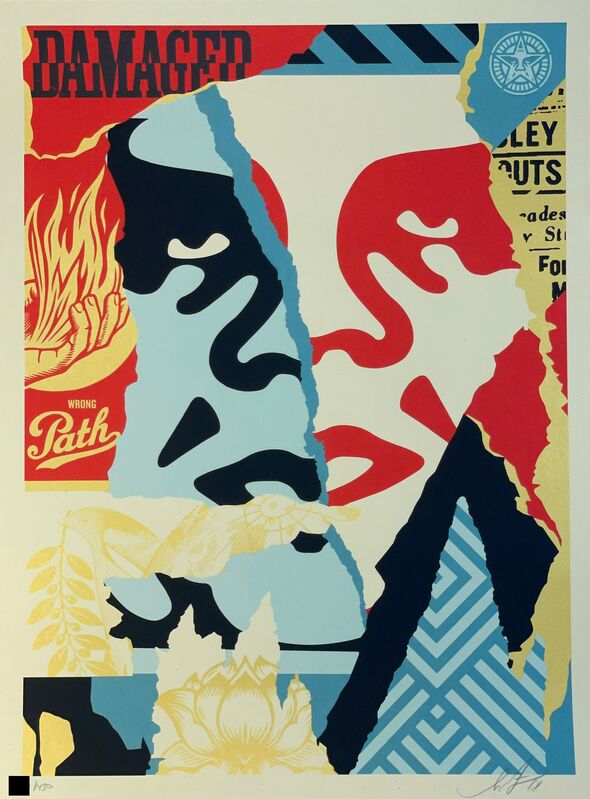
Shepard Fairey, André the Giant Face (OBEY), screenprint. The iconic image that launched Fairey's career as a street artist and became a symbol of his artistic practice. Courtesy Obey Giant.. Source: www.artsy.net
Fairey has been explicit. In statements accompanying the exhibition, he emphasizes that prints offer a "provocative, tactile experience" that digital reproduction cannot replicate. He also declares, "Printing still matters!" The exclamation point is characteristic, and so is the insistence on material presence in an era of frictionless circulation. Collectors who bought early Obey editions for a few hundred dollars understood the appeal. The question now is whether institutional framing changes the terms.
The Museum Circuit and What It Signals
Museums are giving the work a second life, and a different kind of authority. "Facing the Giant: 3 Decades of Dissent" opened at the Butler Institute of American Art in Youngstown, Ohio, on June 7, 2025, and will travel to the Carnegie Arts Center in Turlock, California (September 19 through December 27, 2025), the Jules Collins Smith Museum of Fine Art at Auburn University in Alabama (January 21 through May 11, 2026), and the Lyman Allyn Art Museum in New London, Connecticut (June 6 through August 29, 2026). Thirty hand-painted multiples, or HPMs, anchor each venue. These works on paper measure 30 by 41 inches and blend silkscreen with collage. Titles include "Make Art Not War," "Angela," "Nixon Money," and "Mujer Fatale."

Shepard Fairey, Make Art Not War, hand-painted multiple (HPM). Silkscreen and collage on paper, 30 × 41 inches. Featured in the "Facing the Giant" museum tour. Courtesy Obey Giant.. Source: sugarpressart.com
For collectors, the itinerary is not just cultural. It clarifies provenance. When editions move through museums, documentation hardens into a paper trail: catalogues, press materials, loan records, potential acquisitions. An HPM tied to this tour can be easier to authenticate than a poster bought at a street fair. Edition marks in the lower right corner, certificates of authenticity from Obey Giant, and gallery COAs from venues such as StolenSpace in London or Harman Projects remain essential. Fakes circulate, especially among vintage André stickers and early wheatpaste posters. UV light testing and registration alignment help. Documented provenance helps more.
Pricing on these HPMs, editions of 19 or fewer, has historically landed between $10,000 and $50,000 at primary, depending on scale and complexity. No major auction results from 2025 or 2026 appear in current records, though Heritage Auctions, Phillips, and Sotheby's Contemporary Urban sales have moved high-profile Obama "Hope" prints above $100,000 in prior years. The secondary market rewards scarcity and historical resonance. "Hope" commands a premium because it reshaped a presidential campaign's visual identity. Newer dissent-themed HPMs are more speculative, but museum placement signals long-term institutional interest.
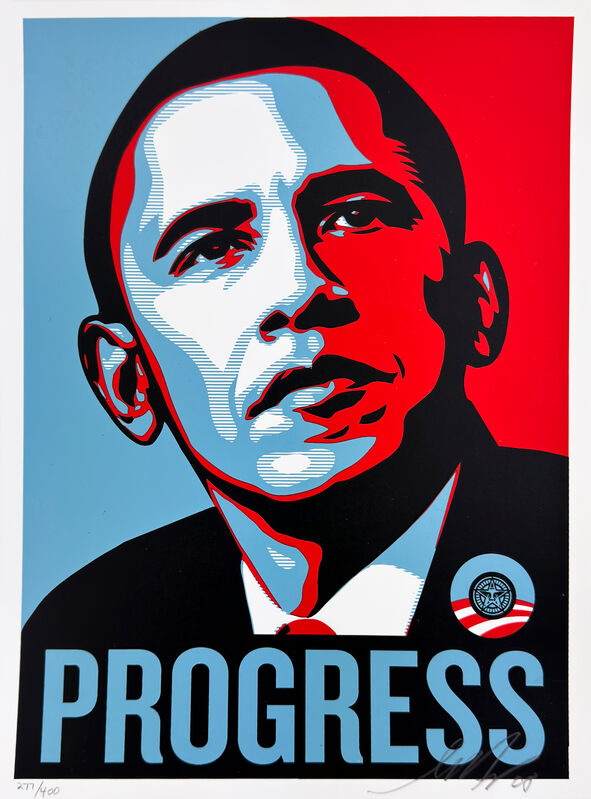
Shepard Fairey, Hope, 2008. Screenprint. The seminal work that redefined Fairey's practice and became synonymous with the 2008 presidential campaign. Courtesy Obey Giant.. Source: www.artsy.net
London, Aspen, Bangkok, and the Group Show Gambit
Fairey's schedule reads like a campaign. Beyond Los Angeles and the museum tour, a group exhibition titled "Triple Trouble: Fairey, Hirst, Invader" runs at a London venue from October 9, 2025, through March 29, 2026. The pairing is instructive. Damien Hirst, the British artist born in 1965 and known for spot paintings and formaldehyde sharks, occupies a different market stratum, with primary works in the millions. Invader, the French artist born in 1969 whose pixelated tile mosaics have colonized cities worldwide, operates closer to Fairey's price range, with mosaics trading above $20,000. All three share a gift for branded repetition and public spectacle. Showing alongside them nudges Fairey further into the blue-chip urban art conversation, even if his editions remain comparatively accessible.

Invader, untitled pixel mosaic installation. The French artist's work appears alongside Fairey and Damien Hirst in "Triple Trouble," underscoring shared strategies of branded repetition and public spectacle.. Source: www.porcelainsuperstore.co.uk
Solo exhibitions keep the pace. "ONE EARTH" ran in Aspen, Colorado, from July 25 through September 30, 2025, emphasizing environmental themes. "Fractured" appeared at Harman Projects (in collaboration with Toyroom Gallery) from June 14 through July 26, 2025, exploring what the gallery described as duality and cultural fracture. "Golden Compass" showed in Bangkok from February 27 through April 27, 2025. "Warning Signs" opened in New Orleans earlier that year. Each venue generates new editions, artist talks, and primary-market opportunities. For collectors seeking to acquire at source, opening receptions offer direct access; the June 14, 2025, artist talk accompanying "Fractured" exemplifies the format.
Prolific output creates its own problem. Obey Giant releases new prints regularly, and the supply of signed, numbered editions is large. Volume tempers scarcity. A collector can own a dozen Fairey prints and still wonder which will appreciate. Historically, the market has favored iconic imagery (the "Hope" poster, the classic André face) and limited HPMs over standard editions. Museum-tour exclusives and hybrid stencil works offer one way to hedge against print saturation.
What Separates Good Examples from Great Ones
Condition is the quiet divider. Screenprints are robust, but paper yellows, inks fade under UV exposure, and creases from poor storage diminish value. Serious collectors frame under museum glass with UV filtration and store unframed works flat, interleaved with acid-free tissue. An otherwise identical print in pristine condition can command a 30 percent premium over one with edge wear or foxing.
Authentication is straightforward for recent editions, murkier for early work. Prints purchased directly from Obey Giant or authorized galleries typically come with certificates. Secondary-market acquisitions require scrutiny. Edition numbers should appear consistently in the lower right; variations in typeface or placement can signal problems. StolenSpace and Harman Projects maintain records that can verify provenance for works that passed through their hands. The Associated Press lawsuit from 2008 through 2010 over the "Hope" image, settled out of court, added legal complexity to that poster's history, though authenticated versions remain highly liquid.
For collectors already holding Fairey pieces, the current exhibition cycle offers context and, potentially, a reason to expand. "Out of Print" in Los Angeles compresses the arc of his printmaking into a single space, useful for locating any given work within the chronology. The museum tour lends institutional weight to dissent-themed HPMs. The London group show places Fairey alongside artists with higher price ceilings, a reminder that the market is still recalibrating his position.
Fairey turned 56 in February 2026. The output shows no sign of slowing, and the political commitments remain visible in every exhibition statement. The market for activist printmaking is smaller than the market for decorative abstraction, but it is passionate and historically minded. Collectors who believe images shape political memory, who watched the "Hope" poster enter the Smithsonian, already understand the wager. Which images will still resonate when the next crisis arrives? That question never gets easier to answer.